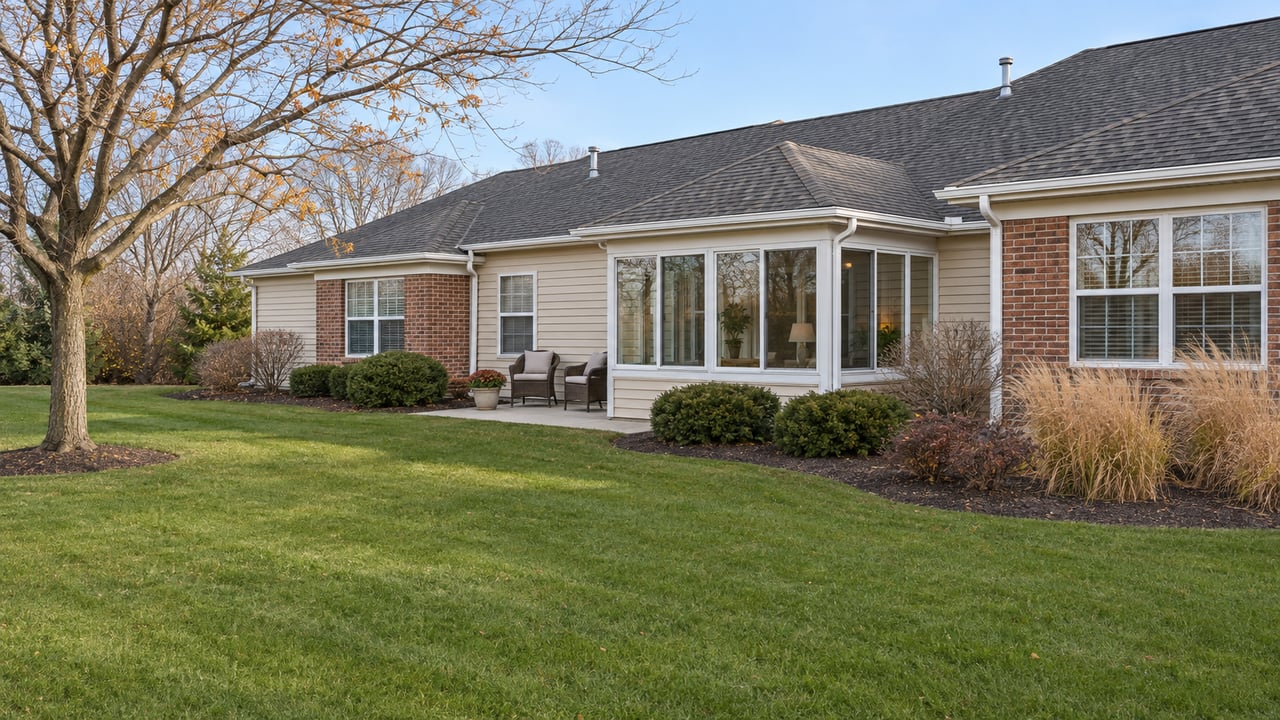
Two-bedroom ranch homes face the Links golf course on several streets inside Carillon's gates. From the fairway they look alike. On paper they can belong to two different homeowners associations. Each association has its own board, management company, reserve fund and list of what the monthly assessment pays for.
Carillon is a gated 55-and-older community in Plainfield with 2,097 homes. Every owner pays the master association, the Carillon Adult Master Association or CAMA, $126 a month to maintain the common areas and community facilities. Every owner also belongs to one of 16 neighborhood associations, and each one sets its own fee. According to CAMA's FAQ, those fees "vary and are largely dependent on whether you have a single-family residence or live in attached housing." A Carillon home has two layers of dues, and the neighborhood layer is the one that changes from street to street.
So a buyer comparing homes in Carillon is comparing associations as much as houses. The fee printed on a listing is the price of a bundle, and the bundles differ.
The same gate, different bundles
CAMA's $126 covers the shared amenities. The Dover association's page describes lakes, walking paths, fitness stations, tennis, bocce and shuffleboard courts, and a clubhouse with party rooms, a workout facility, and indoor and outdoor pools. Golf is the one amenity the fee doesn't pay for. CAMA's FAQ says the Links at Carillon is independently owned, separate from the community, and charges standard green fees, with memberships available for frequent players.
Above that shared layer, each neighborhood decides what its own assessment covers. Some cover nearly everything outside the front door. Others cover streets and common ground and leave yard work to the owner. The official neighborhood pages on carillonhoa.org describe it this way:
| Neighborhood | Housing | Homes | Built | What the association handles |
|---|---|---|---|---|
| Andover | Attached ranch townhomes | 144 | Began 1989 | Building exteriors, lawn, snow, garbage, streets and driveways, exterior insurance |
| Ashford | Detached single-family | 85 | 1989 | Street and sidewalk snow, parkway trees, garbage; owners pay for their own lawn and snow service through an association-wide contract |
| Aberdeen | Detached | 160 | 1990 to 1996 | Lawn care, snow removal, interior streets, sidewalks, storm sewers |
| Cambridge | Attached ranch townhomes | 145 | 1989 and 1995 | Streets, drives, sidewalks, stoops, roofs, exterior repairs, landscaping, snow |
| Buckingham | Condominiums, four-story building | 48 | 1989 | Building exterior, common areas, landscaping, snow |
| Carlisle | Townhomes and villas | 138 | First residents 1997 | Landscaping, building exteriors, snow, driveways, streets, sidewalks, streetlights |
| Canterbury East | Six-unit buildings, a four-unit building, duplexes | 96 | First residents 2000 | Landscaping, snow, exterior insurance, pond maintenance, waste, driveways, streets, building exteriors |
| Dover | Detached single-family | 214 | Completed 2000 | Community area per its declarations |
| Berkshire | Six-unit attached homes and golf villas | 72 | Completed 2001 | Landscaping, building exteriors, snow, driveways, streets, sidewalks |
Ashford shows why two dues figures can't be compared at face value. Its homeowners pay for lawn and snow service themselves, through a contract the association arranges, while the association pays for street snow, parkway tree trimming and garbage. In a neighborhood like Aberdeen, the association contracts for lawn care and snow removal directly. If Ashford's assessment is lower than Aberdeen's, some of the difference comes back as a separate lawn and snow bill.
CAMA's FAQ says the same about the whole community: lawn and snow fees "may be included in your monthly neighborhood association fees (depending in which of the 16 neighborhoods you live in), or you may be billed individually for these services."
Andover's figures show what a monthly assessment pays for
Most neighborhood pages describe their reserves as healthy or well funded and give no number. Andover gives the numbers. Its assessment was $302 for 2025 and is $317 for 2026. The association has about $1.2 million in reserves and adds about $16,600 a month to them.
Spread across Andover's 144 townhomes, the $16,600 comes to about $115 per home per month, a little over a third of the $317 assessment. The $1.2 million balance works out to roughly $8,300 per home. So more than a third of each Andover owner's monthly payment goes toward future replacements, not this month's lawn care.
Andover's association page says what that saving has paid for. With "careful and prudent planning," the association replaced all roofs and gutters in recent years "without incurring an increase in our monthly assessment." The page also says it tries to keep replacement projects in the regular budget and save the reserves for major work. For an Andover buyer, part of the $317 has already bought something: roofs that are newer than the buildings under them.
Other associations describe their capital work in their own terms. Cambridge's page records driveways replaced from 2003 to 2010 and new roofs on two buildings in 2005 and 14 more in 2012, with later phases scheduled after that. Aberdeen reports resurfaced streets and ongoing sidewalk, curb and storm sewer work. Ashford puts at least 10% of its monthly assessments into reserves for streets, curbs, parkway trees, sidewalks and common ground. Carlisle had a reserve study done in 2013 and pays for its work out of reserves built from monthly assessments. Darlington runs a reserve study every five to six years.
Each association runs its own replacement cycle on its own schedule, and its own owners pay for it.
Construction year tells you where each cycle stands
Carillon was not built all at once. Andover, Ashford, Cambridge and the Buckingham condominium building date to 1989. Carlisle, Canterbury, Bristol and Dorchester came in the late 1990s. Chelsea was finished in 2000, Dover was completed in 2000, and Berkshire in 2001.
About a dozen years separate the first neighborhoods from the last, so their roofs, driveways and streets are at different points in their life spans. An association whose roofs were replaced recently and one whose roofs are original could charge the same assessment today and still be in very different positions. For attached homes, where the association owns the exterior work, this matters more than any interior finish. Two units with matching kitchens can sit in associations a full replacement cycle apart.
Dover shows that detached homes vary too. Its 214 single-family homes come in five styles: Camelback, Greenbriar, Palm Springs, Tanterra and the two-story Sun Valley. Some have full basements. Dover was the last single-family neighborhood built, and it sits within walking distance of the clubhouse. Applegate mixes three housing types in one association: 16 single-family homes, 59 townhomes and one eight-unit coach home building, whose coach homes the Bedford association manages.
How the county numbers apply inside the gate
Outside Carillon, the usual comparison between attached and detached homes is price. In Will County, the Illinois REALTORS third-quarter 2026 report shows 588 condo sales at a $315,000 median and 1,778 single-family sales at a $419,000 median, both up 5.0% from a year earlier. Homes of all types in the county took a median of 22 days to sell that quarter.
Inside Carillon, the choice between attached and detached also moves cost between the purchase price and the monthly payment. Attached associations such as Andover, Cambridge, Canterbury East and Darlington cover building exteriors, and several also cover exterior insurance. An attached owner pays for roofs and siding through dues, pooled with neighbors and planned by a board. A detached owner in a neighborhood like Ashford or Dover pays for the roof, siding and possibly yard care separately, on their own timeline.
Neither choice is cheaper in every case. A useful comparison sets the purchase price plus 12 months of total dues, master and neighborhood combined, next to the reserve balance and the age of each association's last major replacement. The figures above are general information drawn from association materials, not legal, tax or financial advice, so confirm the current assessment and coverage for any specific address with the association and your own advisors.
Quick answers on Carillon's associations
Does the CAMA fee include golf at the Links at Carillon? No. CAMA's FAQ says the course is independently owned, charges standard green fees, and sells memberships.
Which Carillon neighborhoods are detached homes? The association pages describe Aberdeen, Ashford, Bristol, Dorchester and Dover as stand-alone or single-family neighborhoods. Applegate has some single-family homes alongside townhomes.
Are Carillon Lakes and Carillon at Cambridge Lakes part of the Plainfield community? No. Carillon Lakes is a separate 55-and-older community in Crest Hill, and Carillon at Cambridge Lakes is in Pingree Grove. Each has its own associations and fees.
Who manages each neighborhood? It depends on the neighborhood. The association pages name Foster Premier for Andover, Ashford, Cambridge, Darlington and several others. Bedford and Bristol use Advocate Property Management, Chelsea uses Associa, and Carlisle uses Retro Community Management.
If you're weighing a Carillon home, or thinking about selling one, talk with ChristyHuHomes about how one association's dues, coverage and replacement history compare with another's before you set a price or make an offer. Start with a free home valuation, or see more on the Plainfield market.
