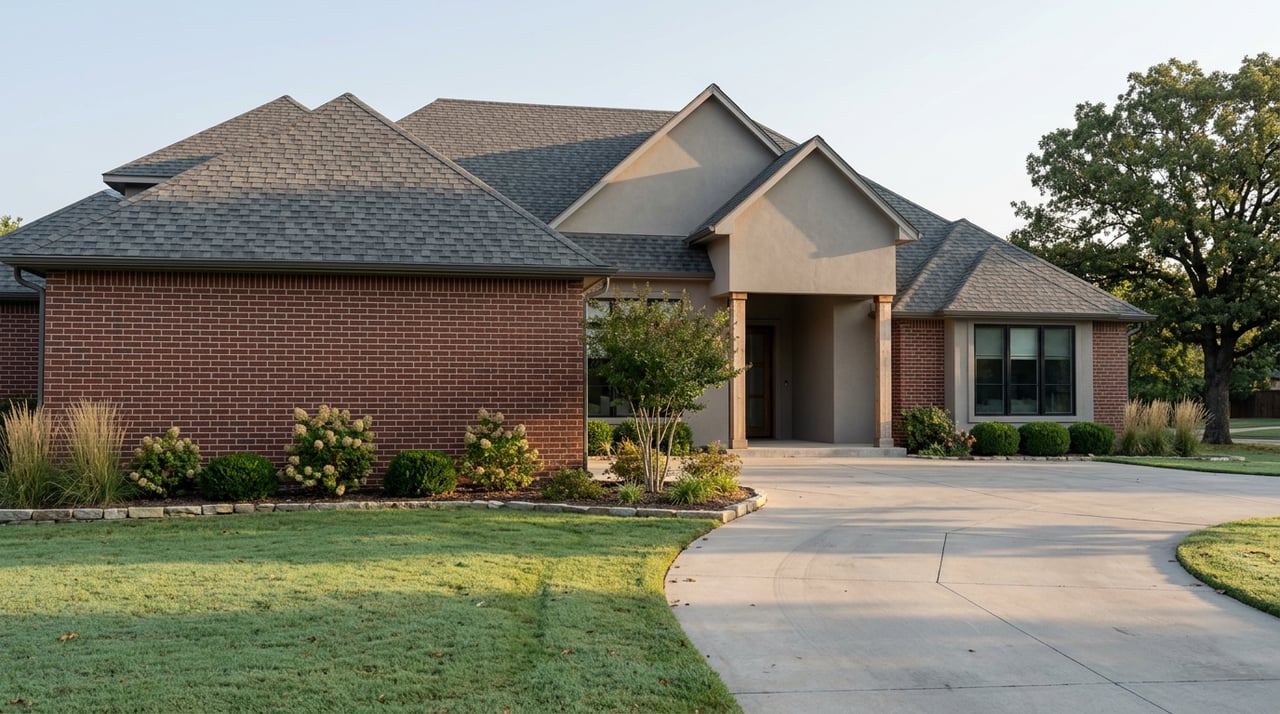
Two colonial-style homes list eight days apart, half a mile from each other, both under contract within a week, both closing at roughly the same price. One seller signs a stack of paperwork that gets recorded in Joliet. The other signs paperwork bound for Yorkville, a different county seat entirely. Neither listing agent flagged it. Neither buyer asked. The line between the two closings runs straight through the middle of the village, and almost nobody who isn't reading a title commitment ever sees it.
Plainfield is not one municipality sitting inside one set of rules. It is a village stitched across two counties and four townships, and that stitching shows up at the exact moment most buyers and sellers are least prepared to deal with it: closing.
A Village Split Down the Middle
Plainfield's Will County side covers Plainfield and Wheatland townships. Its Kendall County side covers Na-Au-Say and Oswego townships. That split is not a historical footnote. It determines which recorder's office receives your deed, which Board of Review hears your property tax appeal, and which office you call when something on the closing statement doesn't match what you expected.
Will County's recorder of deeds and circuit clerk operate out of Joliet. Kendall County's equivalent offices sit in Yorkville. If you don't know which side of the boundary your specific parcel falls on, you don't actually know where your own closing paperwork is headed until your title company tells you.
Here's how the two sides compare on the details that actually surface during a transaction:
| Will County side | Kendall County side | |
|---|---|---|
| Townships | Plainfield, Wheatland | Na-Au-Say, Oswego |
| Board of Review location | Joliet | Yorkville |
| Appeal window opens | August, complaint process for each assessment year | Notice publication, typically mid-September |
| Appeal filing deadline | About 30 days from date of notice | 30 days from newspaper publication date |
Same village. Same MLS number prefix. Two entirely separate government calendars.
Why "No Transfer Tax" Isn't the Whole Sentence
Ask around and you'll hear that Plainfield closings skip a line item other suburbs charge: the Village of Plainfield itself levies no municipal real estate transfer tax. That's accurate, and it's the kind of detail that gets repeated at open houses as a selling point.
It's also incomplete. Title industry ordinance records note that some properties carrying a Plainfield mailing address are not actually inside the Village of Plainfield's corporate limits. They're incorporated into an adjacent municipality that does charge a transfer tax, and the only way to know for certain is to call that municipality's clerk with the address before you assume your net proceeds sheet is right.
A Plainfield mailing address tells you where your mail goes. It does not tell you which government collected your transfer tax.
The other transfer tax layer is not optional for anyone in Illinois. The state charges $0.50 per $500 of sale price, and the county adds another $0.50 per $1,000, customarily paid by the seller. Neither of those depends on which side of the Will-Kendall line you're on. The municipal layer is the one that varies, and it's the one nobody double-checks until a title company flags it days before closing.
The Same Price, Two Different Tax Bills
Property tax rates are not uniform across the village, and the spread is large enough to change how a buyer thinks about long-term carrying cost. Within Plainfield's Kendall County footprint, the 60585 ZIP code carries a median effective property tax rate of 2.69 percent, while 60586 sits at 2.29 percent, a 0.40 percentage point gap on homes that can carry a similar sale price. That gap shows up starkly in actual bills: the highest median tax bill in the village runs $14,083 a year, the lowest runs $7,964, nearly double for property that might look identical from the street.
Kendall County's overall effective property tax rate of 2.37 percent already ranks 5th highest among Illinois's 102 counties. Combine that county-wide pressure with the ZIP-level variation inside Plainfield itself, and two buyers comparing similarly priced homes are often comparing very different long-term tax exposure without realizing it. At closing, this also affects the seller's side of the ledger, since prorated property tax credits are calculated off the current bill, and a bigger bill means a bigger credit changing hands at the table.
The Appeal Clock Is Already Ticking
This part is timely right now, not hypothetical. Will County's Board of Review complaint process for the current assessment year opens in August, which means if your parcel sits in Plainfield or Wheatland township, that window is open or closing as you read this. Miss it, and the Board of Review is barred by law from accepting your complaint for that township, full stop, regardless of how legitimate your case is.
Kendall County runs on a different trigger. Each township's assessment notice publishes in the local newspaper, typically in mid-September, and the clock starts from that publication date, not from a fixed month. If your Plainfield parcel sits in Na-Au-Say or Oswego township, your appeal window hasn't opened yet, and it will open on a date tied to when your specific township's notice runs in print.
For anyone closing on a Plainfield property this fall, that timing matters in a very practical way. A buyer who wants to challenge the assessed value they're inheriting needs to know which county's clock applies to their parcel and whether that window is already running. A seller who filed or considered filing an appeal needs to know that decision doesn't automatically transfer with the deed. It's township-specific and it resets with ownership.
What to Confirm Before You Sign Anything
A short list, worth running through with your title company or attorney before you're staring at a closing disclosure for the first time:
- Which township your specific parcel sits in, not just which ZIP code or mailing address it uses
- Whether the property is actually incorporated into the Village of Plainfield or into an adjacent municipality with its own transfer tax
- Which county recorder and circuit clerk will process your deed, Joliet or Yorkville
- Whether your township's Board of Review appeal window is currently open, and when it closes
- The current effective tax rate and most recent bill for the specific parcel, not a village-wide average
None of this shows up on a standard listing sheet. All of it shows up on the closing statement, the deed, or the tax bill within the first year of ownership.
Frequently Asked Questions
Does this affect buyers as much as sellers? Yes, though differently. Sellers deal with it through the transfer tax question and the prorated tax credit at closing. Buyers inherit it through the recorder's office handling their deed and through whichever Board of Review calendar governs any future appeal on the parcel they're purchasing.
How do I find out which township my parcel is in? Your title commitment will name the county. From there, the property record card, available through the county assessor's office, lists the specific township. It's a five-minute lookup that saves confusion later.
Is the "no transfer tax" detail still accurate for Village of Plainfield properties? Yes, for parcels genuinely incorporated within the Village of Plainfield's limits. The caveat is confirming incorporation status first, since a Plainfield mailing address alone doesn't guarantee it.
Plainfield's split personality between two counties is not a reason to avoid the village. It's a reason to work with someone who checks the boundary before it becomes a surprise on your closing statement. If you're preparing to buy or sell here, ChristyHuHomes can walk through exactly which office your paperwork is headed to, and what that means for your bottom line, before you're sitting at the closing table finding out for the first time.
